

Latest
Can I afford to live in Prague?
What it costs to live in Prague in late 2026: rent, food, transport, childcare and going out, and the monthly budget a single person can expect.
16 October 2026 · 6 min read
Prague remains relatively affordable by the standards of European capitals, but the cost of living depends heavily on where you live and how much you earn. Housing is the biggest expense, while public transport remains remarkably cheap. For residents on local salaries, however, the gap between Prague and the rest of the Czech Republic can make everyday life increasingly expensive.
Inflation rose to 2.5 per cent in September, up from 1.9 per cent in August, largely because of fuel prices. Food prices continued to fall. The average gross monthly wage across the country was just under 52,000 crowns in the second quarter, although wages in Prague are higher.
Here is a breakdown of the main costs facing people living in the Czech capital.
Housing: the biggest expense
Rent remains the single largest item in most household budgets, with substantial differences between districts.
According to Deloitte's Rent Index for the second quarter of 2026, the average rent in Prague was 462 crowns per square metre a month, down 0.9 per cent on the previous quarter. The national average was 343 crowns. Prague 7 was the most expensive district covered by the index, at 493 crowns per square metre, followed by central districts including Prague 1 and Prague 2.
At the citywide average, a 70-square-metre flat would cost about 32,300 crowns a month before utilities. The same-sized property can cost 10,000 crowns or more less in an outer district than in a central location. The Prague districts directory shows which neighbourhoods belong to each district.
Smaller flats are cheaper, although not necessarily cheap relative to local earnings. Figures compiled by PragueCompass.com put published median rents in mid-2026 at around 19,000 crowns for a studio and 25,000 crowns for a two-room flat. Actual prices vary according to location, condition and size.
Renters should also budget for the initial costs of moving in. Agency fees often amount to one month's rent plus VAT, while deposits of two or three months' rent are common. Our guides to finding a place to rent and renting in Prague explain what to expect.
Buying a property is an even greater financial commitment. Completed apartment sales in Prague averaged 153,100 crowns per square metre in the first half of 2026. New mortgages averaged approximately 4.79 per cent, with the Czech National Bank's base rate at 3.75 per cent from June.
Utilities add several thousand crowns a month, depending on the property, energy consumption and building charges. Many households pay a fixed monthly advance, known as a záloha, followed by an annual reconciliation of actual costs.
Food and everyday essentials
Food prices offered some relief in September, falling by about 3.5 per cent year on year. Eggs, butter and margarine recorded particularly sharp declines.
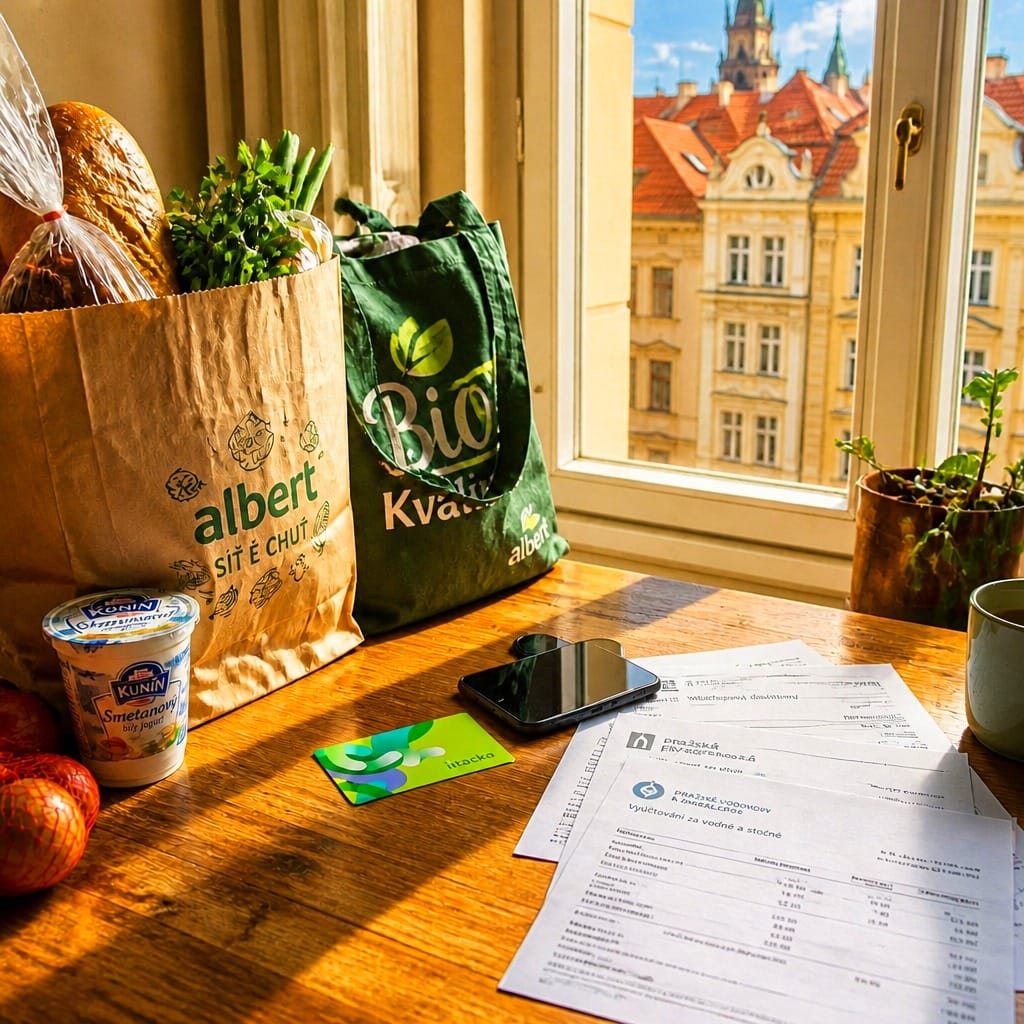
For someone who prepares most meals at home, a monthly supermarket budget of 6,000 to 8,500 crowns is a reasonable guide, according to PragueCompass.com. Shopping habits make a difference: discount supermarkets are generally cheaper than smaller shops in central Prague. Delivery services such as Rohlik.cz and Košík.cz are an alternative for a weekly shop without a car.
Eating out can still be affordable, particularly at lunchtime. A sample of main courses from one restaurant's daily menu averaged about 209 crowns. Traditional weekday lunch menus, or denní menu, at neighbourhood restaurants can cost less.
The picture changes in heavily visited tourist areas, where prices for comparable meals can be several times higher.
Public transport remains a bargain
Prague's integrated public transport system is one of the city's strongest advantages for residents.
A 30-minute ticket costs 36 crowns when purchased through the PID Lítačka app, or 39 crowns on paper. A 90-minute ticket costs 46 crowns in the app and 50 crowns on paper.
Regular users can buy a monthly pass for 550 crowns or an annual pass for 3,650 crowns. The annual option offers particularly good value for anyone who uses public transport throughout the year.
Children, students and people aged over 65 benefit from reduced fares or free travel in many circumstances, subject to the relevant conditions. The Transport section sets out the ticketing rules.
The airport is served by ordinary public transport tickets, although the Airport Express bus requires a separate, more expensive fare.
Driving is less predictable. Fuel prices were in the mid-to-high 40s of crowns per litre in mid-October. Temporary price regulation and a reduction in diesel excise duty were scheduled to run until the end of the month unless extended.
Children and education
Public childcare can be relatively inexpensive, but finding a place is not always straightforward.
For the 2026/27 school year, the monthly fee cap for municipal kindergartens is 1,792 crowns. Individual municipalities can charge less, while the final year of pre-school education is generally free. Meals are charged separately, and places in state facilities can be limited.
International education is considerably more expensive.
The Prague British International School, for example, lists annual fees ranging from 360,000 crowns for nursery provision to more than 760,000 crowns for the upper secondary years. Additional costs, including school transport, can increase the bill. Fees at other international schools vary.
For families moving to Prague from abroad, schooling can therefore become one of the largest expenses after housing.
Beer, leisure and going out
Prague still offers relatively inexpensive leisure options, although prices depend on where residents choose to spend their time.
A half-litre of Czech beer in a neighbourhood pub typically costs between 45 and 80 crowns. In tourist-heavy areas, prices can exceed 100 crowns.
Cinema tickets, theatre performances and gym memberships vary considerably by venue. Official statistics showed a slight monthly decline in prices for recreation, sport and culture in September, although this measures changes in an overall price index rather than the cost of individual activities.
What monthly budget do you need?
PragueCompass.com estimates that a single person living in a well-connected but non-central district, eating out a few times a month and maintaining a modest social life, would need roughly 32,300 to 47,000 crowns a month.
That estimate includes rent, utilities, groceries, public transport, mobile phone and internet costs, and modest leisure spending. Couples and families generally need more, primarily because of larger housing requirements and additional childcare or transport costs.
These are indicative ranges rather than guarantees. Individual circumstances, the condition and location of a flat, and the amount of time spent eating out can all affect the final figure.
The central issue is the relationship between housing costs and local salaries. Prague offers inexpensive public transport, accessible lunch options and relatively affordable everyday leisure, but those advantages can be overshadowed by rent.
For anyone planning a move, the most useful starting point is to establish what housing will cost in the district they want to live in. Once that figure is known, the rest of the monthly budget becomes much easier to calculate.
PragueCompass.com brings together cost-of-living estimates, housing information and transport fares, alongside links to underlying sources, to help residents and prospective newcomers work out what living in the Czech capital is likely to cost.
Data sources
- Deloitte Rent Index — Prague rents, Q2 2026
- Prague British International School — published fees
- PragueCompass.com — rent, grocery and monthly budget estimates